
The Final Glitch: Are We Decoding the End, or Just Seeing the Static
When the machine stops, who remains?

Opening (The Conflict): Across the globe, mainstream media has promoted a comforting narrative: the brain, in its final moments, triggers a “storm” of neural signals. For many, this materialistic explanation resolves the mystery of the “light at the end of the tunnel” and transcendental visions, labeling them as mere hallucinations of a failing biological machine. Researchers such as Jimo Borjigin and her team at the University of Michigan, authors of a widely publicized study that observed gamma wave bursts in dying brains, argue that the phenomenon is a purely physical epiphenomenon. But could we be confusing the mechanism with the purpose?
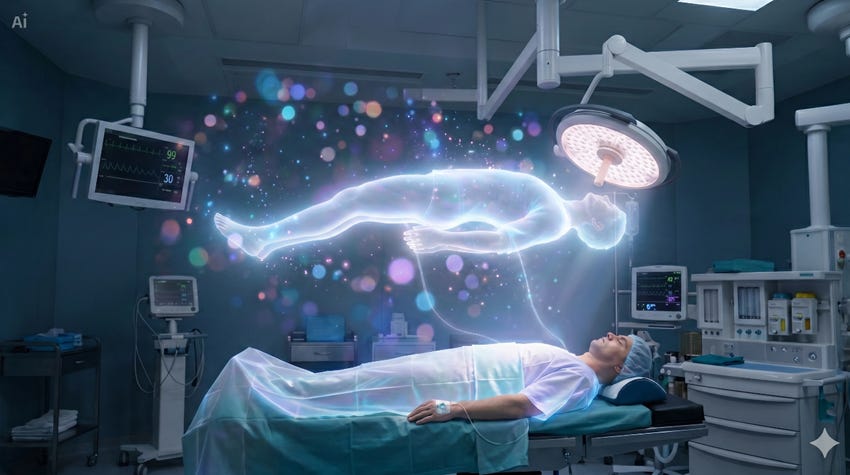
The Science That Dares to Doubt: While neurology attempts to map the “noise” of the hardware, other groups have spent decades cataloging what happens when the signal supposedly vanishes. The Division of Perceptual Studies (DOPS) at the University of Virginia, led by names like Bruce Greyson and Jim Tucker, maintains databases with thousands of Near-Death Experience (NDE) accounts that defy materialistic logic. The friction point is not the neural activity, but the veracity: how can we explain patients who, in a state of clinical death and with flat EEG readings, describe with absolute precision events that occurred outside their field of vision?
What Silence Teaches Us: Perhaps the greatest scientific error is not what we know, but the arrogance of what we assume to be the limit. If consciousness were strictly a byproduct of neural activity, the “blackout” of death should be instantaneous and silent. Instead, we find accounts of cognitive clarity that surpass normal wakefulness, occurring precisely when the brain should be incapable of forming any coherent thought. Are we witnessing the shutdown of a processor, or the liberation of a consciousness that was merely using that processor as an interface?
The challenge: We are all observing the same phenomenon but looking through different windows. Some are content with the explanation of a neural short-circuit; others, fascinated by the persistence of the “self” in the face of nothingness, prefer to investigate the frontier where the visible ends.
The question that remains, and which science has not yet dared to fully answer, is not just whether death is the end, but how much of us exists beyond the frequency our eyes can capture.
If you feel that reality is far greater than the simplistic explanations we are offered, whether in the clash between faith and reason, in the mysteries that science cannot yet reconcile, or in the anomalies that no dogma can contain, you are not alone in this investigation.
In my next article, we will expand this horizon and explore other blind spots of our reality, where science and faith collide without asking for permission.
Don’t settle for the noise. Subscribe free below to receive our full investigations into the unknown directly in your inbox and become part of a community that is not afraid to ask where the mystery truly begins.